Arian Controversy The Defining Christological Debate (325AD)
The Arian Controversy was the most intense theological conflict faced by the early Christian Church. At its core was a single, explosive question: Who is Jesus Christ in relation to God the Father? This debate would ultimately lead to the First Council of Nicaea in 325 AD and shape Christian doctrine for centuries.
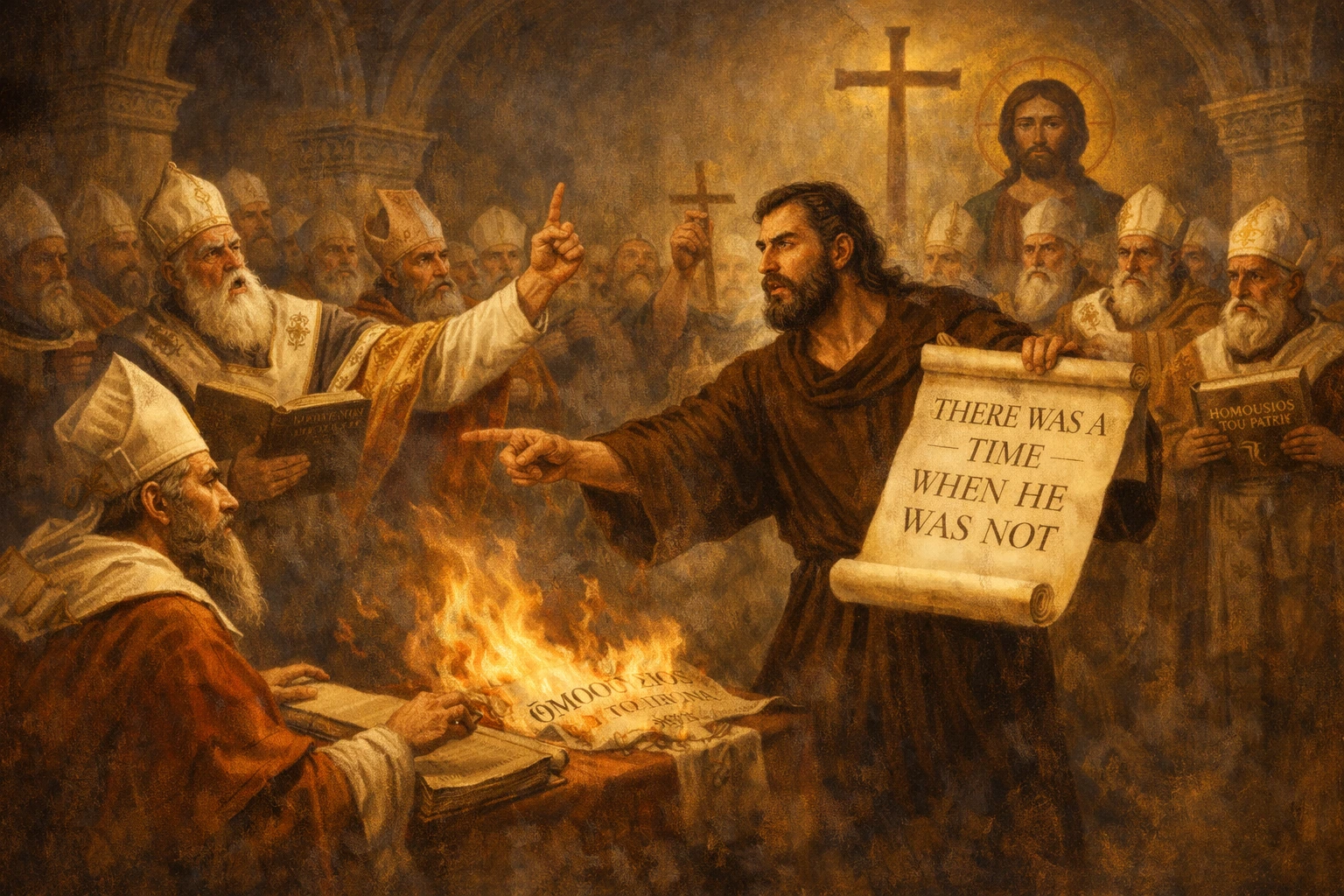
Arian Controversy
The Defining Christological Debate of Early Christianity
The Arian Controversy was the most intense and far-reaching theological conflict faced by the early Christian Church. At its core stood a single, explosive question:
Who is Jesus Christ in relation to God the Father?
This was not a merely philosophical dispute. The answer would determine how Christians understood salvation, worship, divine authority, and the very identity of God. The controversy spread rapidly across the Roman Empire, dividing bishops, congregations, and even emperors, and ultimately led to the convening of the First Council of Nicaea in 325 AD.
The Teaching of Arius
A Created Son, Not Eternal
Arius, a presbyter from Alexandria, taught that Jesus Christ was not eternal but was created by God the Father before time itself. In Arius’ view, Christ was exalted above all creation yet remained distinct in essence from the Father.
According to this teaching, the Son was divine in a secondary sense but did not share the same eternal nature as God. Arius famously summarized his position with the statement:
“There was a time when He was not.”
This idea directly challenged long-held Christian beliefs. If Christ was created, then His authority, His role in salvation, and even the legitimacy of Christian worship were called into question.
The Church’s Response
Defending the Full Divinity of Christ
Many bishops and theologians reacted strongly against Arius’ teaching. They argued that if Christ were not fully divine, then humanity could not be fully redeemed. Salvation, they insisted, required a Savior who was truly God—not a created intermediary.
The defense of Christ’s full divinity was led by figures such as Athanasius of Alexandria, who became one of the most influential voices opposing Arianism. Athanasius maintained that the Son is eternal, uncreated, and equal to the Father, sharing the same divine essence.
This debate was not only theological but pastoral and political, affecting church unity across the empire.
Resolution at Nicaea
One Substance with the Father
The conflict reached its climax at the Council of Nicaea (325 AD). After intense debate, the council decisively rejected Arianism and affirmed that Jesus Christ is:
“Begotten, not made, of one substance (homoousios) with the Father.”
The term homoousios—meaning of the same essence—became the cornerstone of orthodox Christian belief. This declaration was incorporated into what would become the Nicene Creed, providing a clear and authoritative statement on the nature of Christ.
Why the Arian Controversy Matters
Doctrine, Unity, and Christian Identity
The Arian Controversy was not a minor disagreement—it was a defining moment in Christian history. It clarified essential doctrines, strengthened theological precision, and established a unified framework for Christian belief.
More than seventeen centuries later, the outcomes of this debate continue to shape Christian theology, worship, and identity. The questions raised by Arianism forced the Church to articulate, with lasting clarity, who Christ is—and why that truth matters.